Tuesday, 7 March 2017

DATA COMMUNICATIONS

  • Is the very simply, the collection & distribution of the electronic representation of information from & to remote facilities another by means of electrical transmission system likes telephone lines, satellites or coaxial cables.
  • The information can appear in a variety of formats, data, text, voice, pictures,, graphics & video.
  • Prior transmission, the raw information must be digitised.
  • There are 2 type of signal which are analogue signal & digital signal.
  1. Analogue signal - those used by conventional telephone systems, represent data with continuous waves.
    2. Digital signal - Which data is represented by only two discrete states 0s & 1s.
   *Analogue data that is to be sent using digital signal (such as analogue music broadcast by a digital radio station)
   *Digital data to be sent using analogue signal (such as computer data sent over a converted into analogue form before it can be transmitted)


FIGURE 1 : Picture of digital & analogue signal.

there are some video that you can watch :)

Data Transmission

Data transmission has 2 types :
  • Parallel transmission - The message is sent at least one byte at a time, with each bit in the byte taking a separate path.
  • Serial transmission - Data is sent one bit at a time, one after the other along single path.      
There are 3 serial transmission modes which are Synchronous transmission, Asynchronous transmission & Isochronous transmission.
  1. Synchronous transmission - data is organized into group / blocks of data, which are transferred at regular, specified intervals.
  2. Asynchronous transmission - data is sent when it is ready to be sent, without being Synchronous transmission. To identify the bits that belong in each byte, a start bit & stop bit are used at the beginning & end of the byte.
  3. Isochronous transmission - data is sent at the same time as other related data to support certain types of real-time applications that require the different types of data to be delivered at a proper speed for that applications.
FIGURE 2 : Picture of parallel & serial transmission.


FIGURE 3 : Picture of synchronous, asynchronous & isochronous transmission.

There is the video that you can watch :)
https://www.youtube.com/watch?v=PJ_bS7meE7s

Data Flow / Data Move
  1. Simplex transmission - data travels in a single direction only (like doorbell). Relatively uncommon in data transmission because most devices that are mainly on-directional, e.g, printer.
  2. Half-Duplex transmission - data can travel in either direction, but only in one direction at a time, e.g, walkie-talkie.
  3. Full-Duplex transmission - data can move in both directions at the same time, e.g, telephone.
FIGURE 4 : Picture of simplex, half-duplex & full-duplex.

There is the video that you can watch.


HOPE YOU WILL ENJOY WITH THIS NOTE :)

INTRODUCTION TO TELECOMMUNICATIONS

Communication
  • is the mechanism through which human relations exists and develop.
  • is the simply the imparting (memberi), conveying (menyampaikan) or exchange of thoughts, message, ideals, knowledge or information by sign or sound like speech, signal, writing or behaviour.
  • simply the sharing of an orientation toward a set of informational sign.
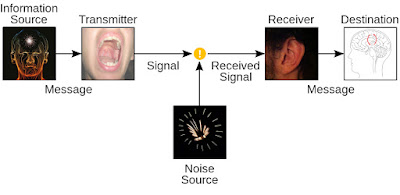
  • Communication process involves 6 basics elements which are :
  1. Sender / source (encoder)
  2. Message
  3. Channel
  4. Receiver (decoder)
  5. Noise
  6. Feedback
Communication model


Telecommunications - is over long distance, cover all forms of distance & conversion of the original communications, including radio, telegraphy, television, telephony, data communication & computer networking.

Development of Communications Technology & Computer Technology


Here the link that you can watch about the development of communication technology & computer technology. Hope you enjoy :)
 https://www.youtube.com/watch?v=be3KZDFvDeA
https://www.youtube.com/watch?v=v94EH_cE7GY

6 Elements of Communication Technology & Computer Technology

  1. People
    • professional - who write the programs that computer use. e.g, programmer, computer engineer, etc.
      • end user - including electronically preparing a client's taxes, an office worker using a word processing program to create a letter, a parent e-mailing his/her child's teacher, a person shopping on line, etc.  
          2. Procedure - is a clear specification for the sequence, timing, execution or a process.
          3. Data / information
      • data - raw, unorganised facts.
      • information - data that had been processed into a meaningful form.
      • e.g, bit, byte, kilobyte (KB), megabyte (MB), etc.
         4. Hardware - physical parts of a computer.
                             - hardware component can be internal (located inside the main box/system unit of
                              computer) or external (located outside the system unit & connected to the system
                               unit via a wired / wireless connection)
                             - there are 5 categories computer operations which are input device,processing
                               devices, output devices, storage devices & communications devices.

          5. Software - the programs or instructions used to tell the computers use what to do.
                               - 2 types of software :
      • system software - the program that allow a computer to operate a collectivity referred to.
      • application software - consists of programs designed to allow people to perform specific tasks using a computer. e.g: playing games, watching videos, listening to musics, exchanging e-mail, etc.
          6. Communication / connectivity - the transmission of data from one device to another.
                                                                - such as, sending/retrieving data via the Internet,accessing
                                                                   information located in a shared company database or
                                                                   exchanging data/e-mail message with others.

    THAT'S ALL .. HOPE YOU WILL ENJOY IT  :)